The Parable of Unity
A laywoman wandered across a deserted square until she strayed into the narrow backstreets of the stone city. This white city shone so brilliantly with its whiteness that it dazzled the eyes. In one of the alleys she saw a gingerbread seller.
He was hawking homemade gingerbread. In one of them she saw this city, this square, filled with flowers and people. And she asked:
“Why is it so deserted now, why is there not a soul there?”
He raised his eyebrows in surprise and said:
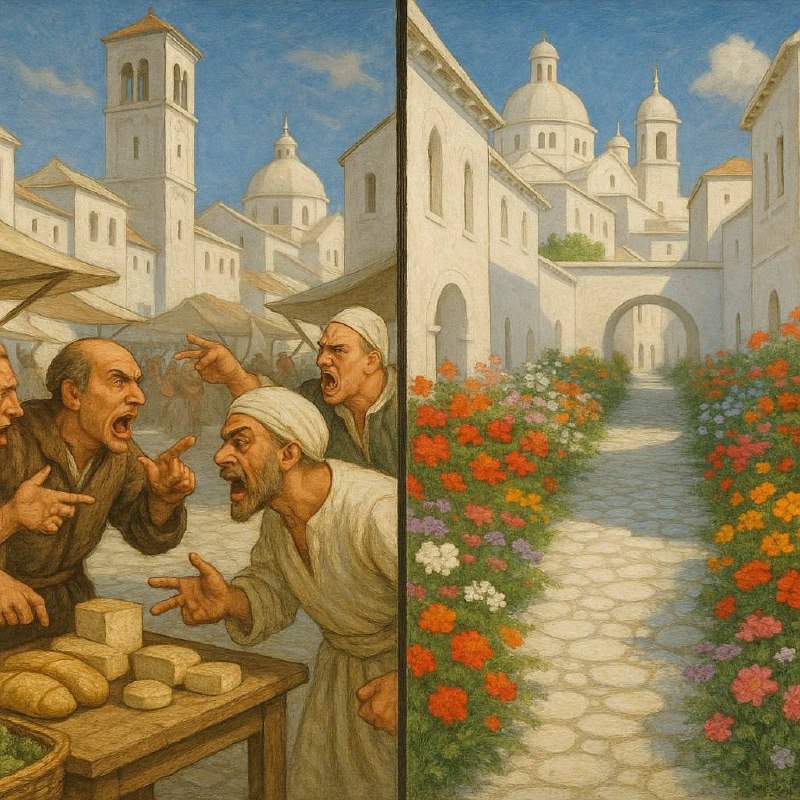
“Haven’t you heard the legend about a certain ostler who came to the square to sell manure, horse dung? They drove him away at once, deeming it unworthy to trade in such lowly goods. They turned up their noses, shouted, gesturing wildly.
A terrible scandal erupted, but the ostler stood quietly, listening to the malicious insults and barbed words hurled at him. Then he said to them,
‘Why do you shout about the importance of your wares? Baker, will bread grow if there is no fertilizer? Butcher, will the livestock thrive if there is no bountiful harvest? Even the potter, without sustenance, cannot shape his pots. Yet you look only at the surface, at that which is familiar to you, passed down mouth to mouth, from generation to generation, for you inherited your craft. So remain without that which you scorn and shout against.’
Soon the harvests became so meager that there was nothing to bake bread with, and the livestock wasted away. People, starving, implored for crops, for that very fertilizer they had turned up their noses at and shouted against, waving their arms in outrage.
From that time on, no market has been held on that square. But each year, on the day the ostler came to the square, it is adorned with flowers of invisible beauty, commemorating the very cyclicity of life and the importance of every stage of its manifestation. All is for the good in the cycle of life, and without one thing there will be no other. When they understood this, the harvests returned, the animals recovered, and the people ceased to starve.
‘Then why is there no longer a market there, I don’t understand?’
‘They constantly quarreled, each praising his own goods, wanting to be better than his neighbor. But when the ostler came, they shouted louder than usual. They left not because they fled, but because they grasped the value of the lesson brought before them and no longer wished to boast of themselves and their wares, no longer wished to be noticed, to be first, but became singular in their roles.
Each opened trade at his own home, as a tribute to tradition, as an honor to the place from which their strengths, skills, and craft arose. For the square, a place where people gather, is a place of life’s flourishing, not of contest and greed.
Therefore the flowers framed that square with their beauty, refinement, and love, so that everyone who came there would become a little happier and freer from burdensome thoughts.
Now, gathering on the square, people gave one another only smiles, looking at the flowers that symbolized that very cycle of life, without which the existence of all beings is impossible.’
The Parable of Unity A laywoman wandered across a deserted square until she str…